
The Abstraction Layer: Why Private Estate Teams Must Serve the Enterprise, Not the Individual
Every private home begins with an idea of how the family wants to live.
The role of an estate team is ultimately to protect and deliver that vision. As homes, teams and portfolios become more complex, however, the structure behind them must evolve too.
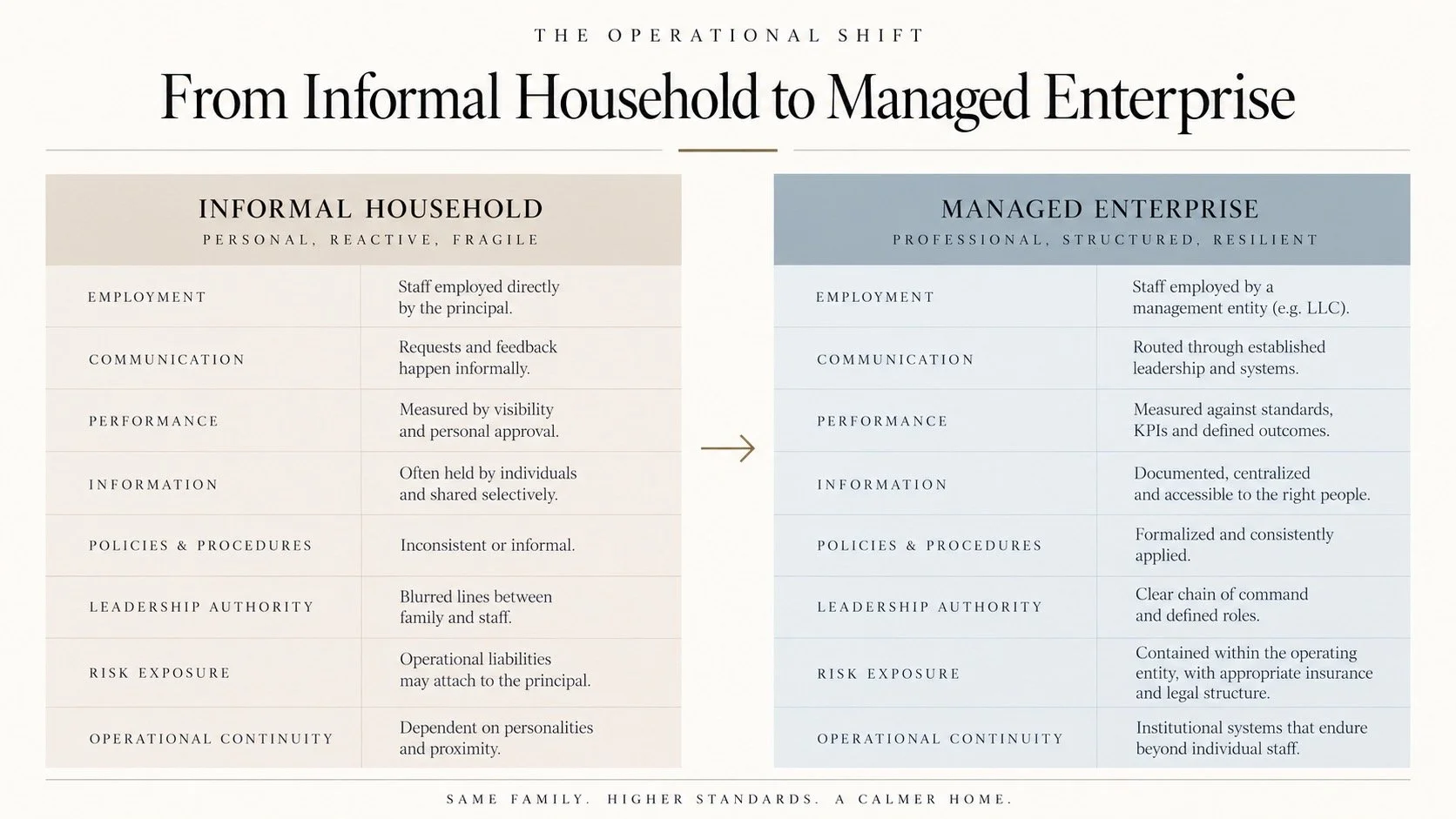
When the family is also the direct employer and natural center of the operation, professional and personal relationships can easily overlap. Familiarity and trust are essential to exceptional private service, but without a clear operating structure, information, decisions and accountability can become increasingly dependent on individual relationships.
None of this is deliberate. It is a natural consequence of working closely together inside a private environment.
The answer is not to create greater distance from the family. It is to build the right structure around them.
A dedicated operating entity, typically an LLC or management company, creates an important layer between the family and the people, systems and responsibilities required to support them.
This does not move the team away from serving the Principal. It allows them to serve the Principal more completely.
The enterprise exists to protect the Principal's vision for the home.
Protecting the Experience of Home
Exceptional private service is deeply personal.
A housekeeper understands how a room should feel. A chef knows the family's preferences. A driver understands schedules and rhythms. An Estate Lead anticipates what will be needed before it is requested.
That knowledge and intuition are essential.
But the family should not need to manage everything required to make that experience possible.
Maintenance must happen. Security protocols must be followed. Vehicles must be inspected. Budgets must be managed. Vendors must be coordinated. Information must reach the right people.
The stronger the structure behind the home, the less visible those mechanics need to be to the family.
That is the abstraction layer.
It allows the team to focus not simply on individual requests, but on protecting the broader environment the Principal originally envisioned.
The Management Entity
The structure is simple:
Principal → Vision + Intent
Management Entity → Structure + Standards + Accountability
Estate Team → Execution + Service
The Principal establishes the vision and intent for the home.
The management entity translates that intent into people, systems, budgets, standards and accountability.
The estate team brings it to life through thoughtful, consistent service.
Serving the enterprise therefore does not compete with serving the Principal. The enterprise is the mechanism through which the Principal is served.
It preserves their preferences beyond any one employee, creates continuity across homes and teams, and ensures that the quality of the experience does not depend on the Principal personally managing it.
Protecting the Family
There is also a practical reason for this separation.
Large private estates often carry the complexity of businesses, with employees, vehicles, infrastructure, construction, security and significant vendor networks.
A properly structured management entity can help separate those activities from the family and the ownership of their underlying assets. Employment agreements, vendor contracts, insurance, policies and operating procedures can sit within one coherent framework.
The exact structure will vary by family and should always be established with appropriate legal, tax and insurance counsel.
But the operational objective remains the same: protect the family while preserving the experience they want from their homes.
Structure Is Not Enough
An LLC provides the framework, but leadership and culture make it work.
The Principal establishes the vision, priorities and standards. Estate leadership translates those into an operating model capable of delivering them consistently.
Preferences become standards.
Expectations become roles.
Requests become procedures.
Priorities become budgets and schedules.
Individual knowledge becomes institutional knowledge.
This is how a Principal's intent survives growth, new homes, changing teams and increasing complexity.
The structure protects the vision rather than replacing it.
From Proximity to Stewardship
A strong estate culture gives teams a clear definition of success.
The question becomes broader than whether an individual interaction went well. Did we anticipate what was needed? Did we protect the asset? Did we uphold the family's standards? Did we make the home work better? Did we make the family's life easier?
This shifts the culture from proximity to stewardship.
It also gives good employees the clarity to take professional pride in their work and understand how their individual role contributes to something larger.
A Home That Still Feels Like Home
The best private operations are often the least visible.
Maintenance happens before something breaks. Budgets are monitored. Staffing issues are managed. Security protocols are followed. Information reaches the right people.
The family experiences the home rather than the machinery required to operate it.
That is ultimately why the enterprise exists.
Not to make the home corporate. Not to create unnecessary distance between the team and the family. And certainly not to diminish the deeply personal nature of private service.
It exists to preserve the Principal's original vision for how the home should feel and how the family should be able to live within it.
Service stays personal. The structure behind it stays professional.
For families managing multiple homes, growing teams or increasingly complex operations, the question is not simply Who do we need to hire?
It is What operating model will best protect the way we want to live?
Define the vision first. Build the operating model around it. Then build the team capable of delivering it.
Because ultimately, serving the enterprise well is how we serve the Principal well.
And when the structure is working as it should, the family should feel very little of it at all.
They should simply feel at home.