
In private estate management, some of the most valued members of a household team are those who have been there the longest.
A housekeeper who has worked with a family for twenty years, a chef who understands the smallest preferences, or an estate manager who has supported a family through multiple homes and generations brings something that cannot easily be replaced: trust, familiarity, institutional knowledge, and a deep understanding of how a family lives.
That loyalty matters enormously. It should be recognized, respected, and rewarded.
Yet one of the challenges we see in long-established households is that compensation can evolve over time without the same structure or consideration given to other areas of estate operations.
Annual increases are made with the best intentions. A Principal wants to acknowledge loyalty, reward a demanding year, or ensure someone they care about is keeping pace with the cost of living.
Over time, however, these decisions can create compensation structures that are difficult to sustain, inconsistent across a team, and sometimes disconnected from the responsibilities of the role itself.
At Hardman & Associates, we believe the answer is not to limit generosity. It is to create a more thoughtful framework for how loyalty, performance, employee wellbeing, and long-term compensation work together.
1. Recognizing Loyalty Without Losing Sight of the Role
One of the more common challenges in established estates is the compounding effect of annual salary increases.
Consider an employee earning $100,000 annually who receives a 10% increase each year. After five years, their base salary will have grown to approximately $161,000. At 15% annually, that same salary would reach approximately $201,000.
While each adjustment may feel entirely reasonable, the cumulative impact can be significant.
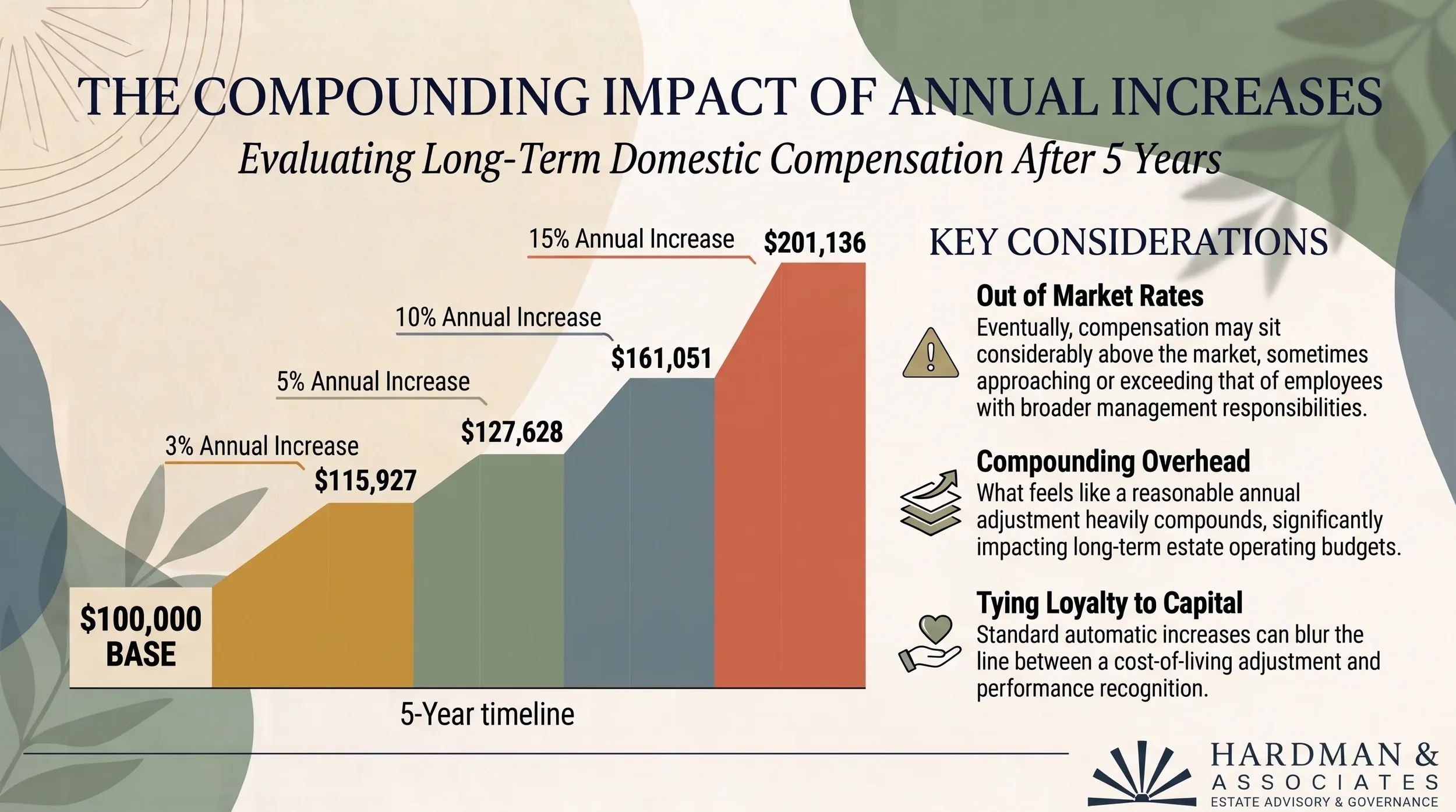
Eventually, compensation may sit considerably above the market for the position, sometimes approaching or exceeding that of employees with substantially broader management responsibilities.
This is not necessarily a reflection of anyone being overvalued. Rather, it is often the result of decisions made individually, without the benefit of a longer-term compensation strategy.
In California, where overtime requirements, payroll costs, and employment obligations are particularly complex, the financial implications extend beyond base salary.
For illustration, an employee earning $150,000 may represent a total annual employer cost of $180,000 to $210,000 or more, depending on benefits, insurance, overtime, and employment arrangements.
Across a household team of ten or fifteen people, these decisions can have a substantial effect on the operating budget.
There is also a cultural consideration.
When compensation becomes disconnected from role responsibilities, it can create uncertainty around leadership, accountability, and expectations.
Our view is that tenure should be valued, but compensation should remain connected to the role, the market, and the contribution being made.
The objective is to protect both the employee and the long-term health of the household.
2. Separating Cost of Living, Performance, and Recognition
We believe there is real value in distinguishing between three elements of compensation:
Cost-of-living adjustments: Helping employees maintain purchasing power as everyday expenses increase.
Market and role adjustments: Ensuring compensation remains appropriate for the position, responsibilities, and employment market.
Performance and recognition: Rewarding exceptional contribution, commitment, flexibility, and service.
These are different considerations and should not automatically result in the same compensation decision.
For annual salary planning, we generally favor a measured approach informed by inflation, market conditions, and the individual's position within an established salary range.
Core CPI plus approximately 1% to 2% may provide a useful planning reference in certain circumstances, rather than a fixed formula or automatic entitlement.
There will always be situations where expanded responsibilities, market changes, or individual considerations justify a different approach.
What matters is that the decision is deliberate.
Where a Principal wishes to recognize exceptional performance or extraordinary commitment, we often see greater value in a meaningful annual bonus rather than automatically incorporating the entire reward into permanent base compensation.
Depending on the role, contribution, and financial parameters, a bonus of 5% to 15% of annual base salary might serve as an illustrative planning range, with larger awards considered where appropriate.
These percentages are not universal standards, but examples of how a family might approach recognition more intentionally.
A generous year-end bonus can make a significant difference to an employee and their family. It acknowledges the year's contribution in a personal and tangible way while allowing the estate to maintain a more predictable long-term operating budget.
Bonus arrangements must, of course, be properly structured and communicated, particularly in California, where certain bonuses affect overtime calculations.
The intention is not to reward people less. It is to reward them more thoughtfully.
3. Why We Favor Mid-Year Reviews and Employee Self-Reflection
Another practice we increasingly encourage is separating annual performance reviews from year-end compensation decisions.
Traditionally, many households conduct reviews toward the end of the calendar year, alongside salary increases and holiday bonuses.
While convenient, we do not believe this always creates the best environment for meaningful conversation.
When performance and compensation are discussed together, the financial outcome can understandably dominate. Employees focus on what their review may mean for their salary, while managers can be reluctant to introduce difficult feedback during the holiday season.
We prefer a more considered annual rhythm.
May or June: Performance conversations focused on development, communication, responsibilities, and mutual expectations.
October or November: Compensation planning informed by market benchmarks, inflation, operating budgets, and individual circumstances.
December: Year-end recognition and communication of compensation decisions.
Separating these conversations allows each to serve a clearer purpose.
Giving Employees a Voice
An equally important part of this approach is encouraging employees to complete a thoughtful self-reflection before their review.
We believe this can be just as valuable as the manager's assessment.
In private households, employees often work behind the scenes, anticipate needs without being asked, and adapt continuously to the changing rhythms of a family's life.
Their contributions are not always easily measured, and their perspectives are not always heard.
A self-review gives employees the opportunity to consider what they are proud of, where they have faced challenges, how their responsibilities may have evolved, and what support they might need moving forward.
Perhaps most importantly, it gives them a voice.
We believe employees should feel they are part of the conversation about their work, rather than simply the subject of it.
This is particularly valuable for longstanding employees whose roles may have changed considerably over the years, sometimes without formal acknowledgment or discussion.
It is equally valuable for leadership.
Employees often have the clearest understanding of the daily workings of a home. Their observations can highlight processes that are no longer effective, gaps in communication, opportunities for improvement, or responsibilities that need to be better defined.
We encourage a simple, conversational self-review rather than a lengthy corporate assessment.
Questions might include:
What have you felt particularly good about in your work this year?
What has been challenging, and what might have helped?
Have your responsibilities changed or grown?
Is there anything we could do differently to better support you?
What would you like to focus on or develop over the coming year?
These conversations should be honest, constructive, and reciprocal.
Giving employees a voice does not mean every concern can be resolved or every request accommodated. It means creating an environment where people feel comfortable speaking openly and know their perspective will be considered with respect.
A thoughtful review also gives managers an opportunity to clarify expectations, acknowledge contributions that might otherwise go unnoticed, and address concerns before they become larger issues.
The mid-year timing allows approximately six months for meaningful changes, training, or development before year-end compensation decisions are made.
At Hardman & Associates, we believe performance reviews should first and foremost be about the person, their work, their experience, and their development.
A good review should be a conversation, not a verdict.
4. Looking Beyond Salary: The Value of Benefits
In California, we also encourage Principals to consider the full employment package rather than focusing solely on salary.
Comprehensive healthcare, dental and vision coverage, retirement contributions, paid time off, and professional development can have an enormous impact on an employee's sense of security and long-term commitment.
For example, a household contributing $1,000 per month toward an employee's healthcare is providing $12,000 annually in additional support beyond salary.
For many employees, particularly those supporting families of their own, these benefits can be as meaningful as incremental salary increases.
Properly structured employer-sponsored healthcare may also offer tax advantages compared with equivalent cash compensation, depending on the employer, plan, and applicable tax requirements.
More broadly, good benefits send an important message.
They demonstrate that the family values the employee not simply for the work they perform, but as someone whose wellbeing and stability matter.
We have always believed that well-supported employees are better positioned to provide consistent, thoughtful service.
A strong benefits program is therefore not simply an employment expense. It is an investment in the continuity and quality of the household team.
5. Creating a Culture of Fairness, Clarity, and Appreciation
Ultimately, compensation is only one part of a much broader conversation about how people are managed within a private estate.
The most successful households are not necessarily those paying the highest salaries. They are those where employees understand what is expected of them, feel respected in their roles, have confidence in their leadership, and know their contributions are recognized.
This requires consistency, but also sensitivity.
Employees who have spent much of their careers with a family deserve thoughtful consideration. Any evolution in compensation practices should respect existing commitments, established expectations, and relationships built over many years.
We would never advocate abruptly changing an established employee's compensation simply because it no longer aligns with current market data.
Rather, the opportunity is to establish greater clarity moving forward through defined salary ranges, thoughtful bonus planning, regular market reviews, and open conversations.
None of this needs to feel corporate or impersonal.
In fact, greater structure often allows for a more personal and supportive environment because expectations are understood and decisions feel fair.
Our Approach at Hardman & Associates
Private estates are unique environments. They are homes first, and the people who support them often become deeply woven into the lives of the families they serve.
That relationship deserves care.
But the personal nature of domestic employment should not prevent us from applying thoughtful leadership, financial oversight, and good management practices.
At Hardman & Associates, our approach is to balance the human side of estate management with the practical realities of operating complex homes and teams.
We encourage families to keep base compensation grounded, recognize exceptional contributions separately, invest in meaningful benefits, and create space for employees to participate in conversations about their work and development.
Just as importantly, we encourage Principals and estate leadership to understand how today's decisions influence tomorrow's operating costs, team dynamics, and staffing flexibility.
The goal is never to remove generosity or personal connection from the employment relationship.
Quite the opposite.
We believe the best estate teams are built through genuine appreciation, clear expectations, thoughtful leadership, and responsible long-term planning.
When those elements are in balance, families are better supported, employees feel valued and heard, and the home functions as it should: with continuity, trust, and a sense of ease.
Want more on private estate management? Explore more articles on our blog.